Methodology · 7 min
Data quality in football scouting: reading minutes, competition and context
Why scouting data becomes reliable only when minutes, league context and team role are part of the evaluation.
FI-SO 360° Redaktion ·

Good data is not automatically good evidence
More data does not fix poor judgement.
It only makes it faster.
A metric without minutes is a rumour with decimals.
A metric without competition context is a comparison without a scale.
A metric without team role pretends football is a laboratory.
It is not.
Scouting data is strong when it shows its limits.
Weak data hides uncertainty.
Good data marks it.
That looks less shiny.
But it prevents mistakes.


Minutes: sample size matters
The uncomfortable truth: not every number deserves trust.
Some numbers only deserve a follow-up question.
A player with 400 minutes can produce extreme values that may not hold after 2,000 minutes.
Short samples are not useless, but they need a different level of trust than stable season profiles.
For shortlists, minutes should therefore not only be a filter.
They should also be an evidence weight.
A player with a slightly weaker value but a strong minutes base can be more reliable than a player with an elite value in a tiny sample.

Competition: same number, different level
A metric from the 2.
Bundesliga is not automatically weaker than the same metric from a smaller first division.
But it must be interpreted differently.
Tempo, opponent quality, pressing intensity, physical demands and tactical structure can differ significantly.
Every evaluation should therefore show the peer group.
Who was compared with whom?
Same league?
Same position?
Similar role profiles?
Without that answer, the number floats too freely.
Team role: values do not appear in a vacuum
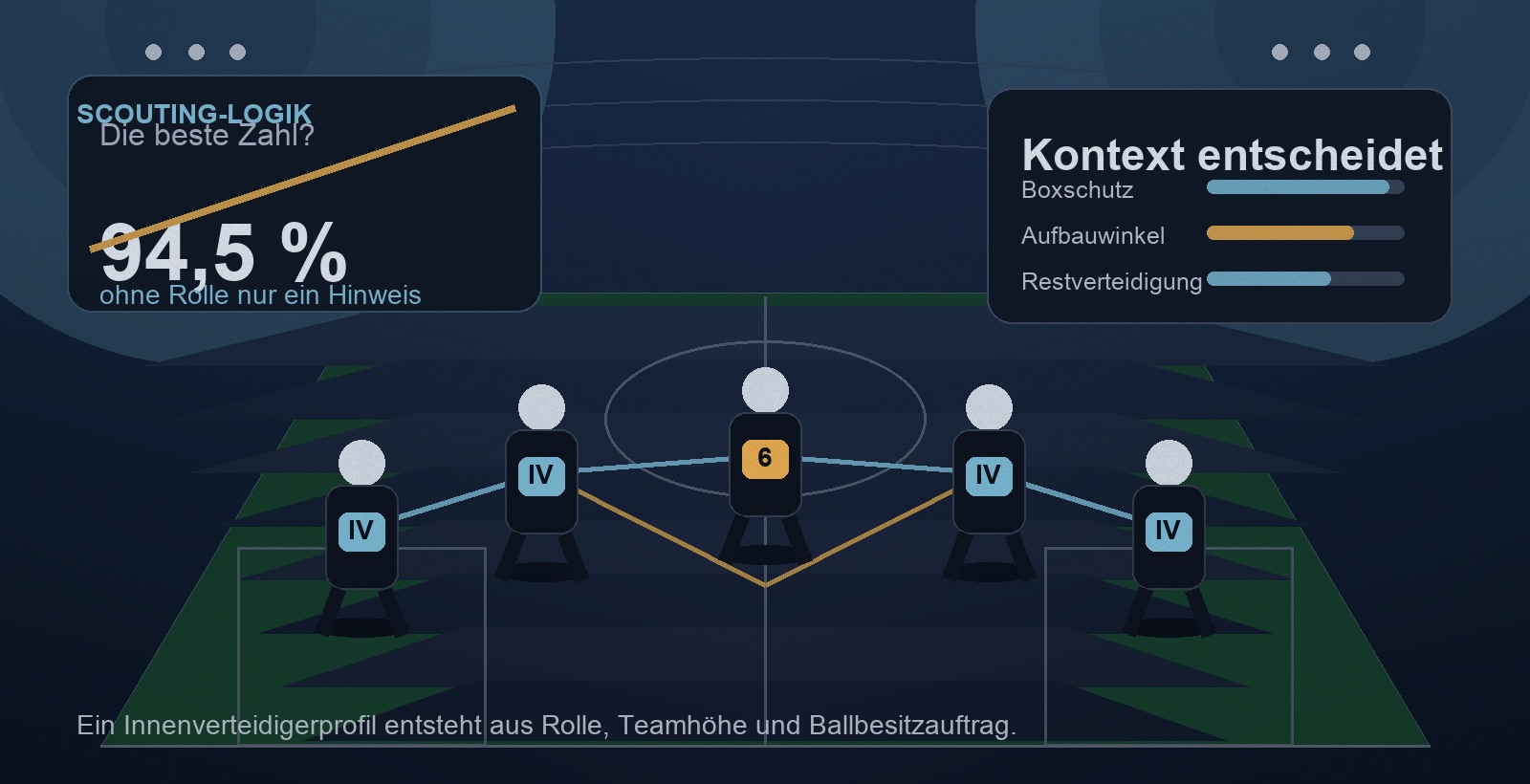
A centre-back in a deep block faces different defensive actions than a centre-back in a high line.
A winger in a dominant possession team receives different shooting and passing situations than a winger in a transition team.
Data quality therefore also means considering the team task.
Otherwise opportunity is easily mistaken for ability.
Practical rules of thumb
Simple quality levels help data-aware scouting:
- high reliability: strong minutes base, suitable peer group, stable role
- medium reliability: useful signal, but limited context or changing role
- low reliability: small sample, unclear position or strong team-context distortion
These levels do not have to be perfect.
They make the shortlist more honest.
Scouts can see faster which candidates deserve deeper work and where video or context checks must come first.
Conclusion
Data quality is not a technical side topic.
It determines whether a scouting signal is reliable.
Teams that account for minutes, competition and team role build better shortlists and protect decisions from false precision.
Availability is not the same as reliability
In many databases, a value is available as soon as it can be calculated technically.
That is not enough for scouting decisions.
A value can be available and still not very reliable.
This happens when a player has few minutes, changes roles frequently or plays in an extreme team context.
Reliability does not ask: is there a number?
It asks: how much trust should we place in this number for this specific decision?
That distinction sounds small, but it changes shortlist work completely.
A candidate with eye-catching data is not automatically a candidate with strong evidence.
Minutes as a trust signal
Minutes are more than a filter.
They are a trust signal.
A player with 350 minutes can have an exceptional value, but his role, opponent selection and game states may distort the result.
A player with 2,200 minutes usually shows more stable patterns, even if his peak values look less spectacular.
This does not mean small samples should be ignored.
Young players or rotation players can send interesting early signals.
But those signals need a different label.
A smaller sample is more often a reason for further checking than a finished decision.
A practical solution is to give data points evidence levels.
Strong minutes and stable role create high reliability.
Medium minutes with a clear role create medium reliability.
Few minutes, changing positions or special roles create low reliability.
The candidate remains visible, but the statement becomes more honest.
Reading competition context
League and competition context are not simple quality stamps.
It would be too crude to say that a first division is always more reliable than a second division, or that a smaller market is automatically less relevant.
Still, the competition must be part of the reading.
A value appears against specific opponents, at a specific tempo and under specific physical and tactical demands.
A full-back may have lots of time to cross in one league and be pressed immediately in another.
A centre-back in a deep team may collect many clearances, while a centre-back in a dominant team defends less often but protects harder open spaces.
Every scouting profile should therefore answer: against which peer group does this value look strong?
Is the player outstanding inside his league?
Inside his age group?
Inside similar roles?
Or only in a mixed dataset that combines too many contexts?
Team role and tactical task
Team role is often the overlooked part of data quality.
Two players in the same position can have completely different tasks.
One winger holds width and delivers crosses.
Another moves inside, connects in the half-space and opens the lane for the full-back.
Their values are not directly comparable, even if the data model assigns the same position.
Reliable scouting work must therefore check whether the statistical output matches the observed role.
If a player has few progressive passes, that may reflect limited quality.
It may also reflect that his team uses him as cover.
If a player has many dribbles, he may be an excellent one-v-one player.
Or he may simply play in a team with few other progression routes.
These questions cannot be solved in the dataset alone.
They need video, match context and sometimes conversations with scouts who have seen the player live.
Interpreting per-90 values
Per-90 values are useful because they normalise playing time.
But they become dangerous when the playing time itself is unstable.
A substitute who often enters against tired opponents can produce strong attacking numbers per 90.
A starter who regularly faces strong opponents carries a different load.
Per-90 values should therefore always be read together with minutes, starts, role stability and opponent context.
They are a comparison tool, not an automatic ranking.
Defensive values need special care because high action volume can also mean that the team has poor control.

Make data quality visible
The most important operational step is visibility.
If a system shows values but not their reliability, decision-makers have to keep uncertainty in their heads.
That does not work well in daily practice.
It is better to show data quality next to the signal.
Simple notes such as “stable minutes”, “small sample”, “role change” or “check team context” can improve a discussion immediately.
Scouts see which candidates are well supported by the data and where the evaluation is still fragile.
This transparency protects against false precision.
It does not make the system weaker.
It makes it more credible.
Teams that show uncertainty openly can make better decisions.
Conclusion
Data quality is the foundation of good scouting work.
Not because numbers must be perfect, but because their limits must be known.
Minutes, competition, team role and tactical task determine how reliable a signal is.
Clubs that integrate these factors build shortlists that are not only statistically interesting, but also football-relevant.
That is the difference between data as decoration and data as decision support.
Data quality is also a communication problem
Even when analysts understand uncertainty internally, it often does not reach the decision room.
A table full of numbers automatically looks objective.
People who do not work with data every day rarely see immediately which values are stable and which are only early hints.
Data quality must therefore be communicated in the interface and in the report.
Simple labels can help: “high evidence”, “check”, “small sample”, “role change”, “strong context effect”.
These labels are not just technical metadata.
They translate uncertainty for coaches, sporting directors and board members.
They show when a number can be used as a strong argument and when it is only a path for further analysis.
Missing data must not be hidden
Missing data is not an embarrassing system failure.
It is part of reality.
Not every league provides the same depth.
Not every player has enough minutes.
Not every metric is available or meaningful for every role.
It becomes a problem only when those gaps are invisible.
A strong scouting process shows missing data openly.
The club can then decide how to respond: add video work, prioritise live scouting, use alternative metrics or weight the candidate lower for now.
Hidden gaps create false precision.
Open gaps create better questions.